
Preventive vs Reactive Maintenance: Which Strategy is Right for Your SA Operation?
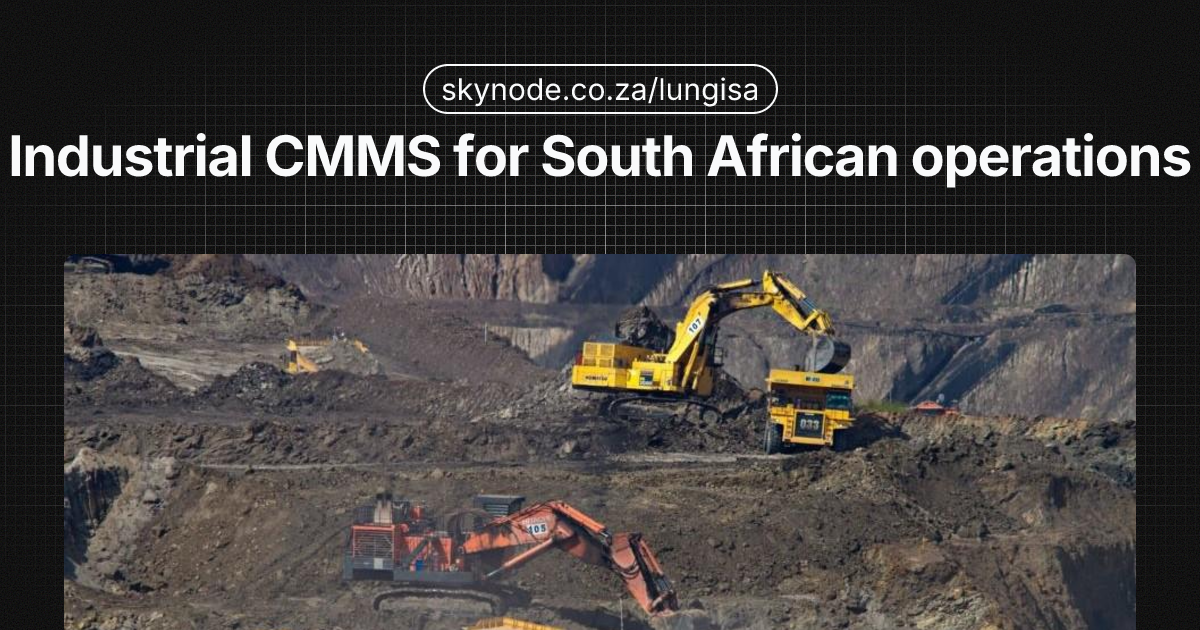
The choice between preventive vs reactive maintenance shapes your downtime, safety record, and bottom line. In South Africa, where load-shedding, skills shortages, and strict safety regulations add pressure, getting that choice right matters even more.
This guide walks you through what each strategy means, when each makes sense, what it costs, and how to move from firefighting to planned maintenance — with real examples from mining, manufacturing, and facilities in the SA context.
What is Reactive Maintenance?
Reactive maintenance (often called run-to-failure) means you fix equipment only after it breaks. There is no scheduled inspection or servicing; work is triggered by failure, breakdown, or a complaint.
How it works in practice
- No planned tasks: maintenance is done only when something stops working or is clearly broken.
- Urgent call-outs: technicians respond to failures, often outside normal hours.
- Replacement or repair on the spot: decisions are made under pressure, with limited time to source optimal parts or plan the job properly.
When reactive maintenance is the default
Many operations drift into reactive maintenance because of pressure: tight budgets, understaffed teams, or a culture where “if it isn’t broken, don’t touch it.” In the short term it can feel cheaper because you aren’t spending on scheduled servicing — but the long-term cost is usually much higher.
What is Preventive Maintenance?
Preventive maintenance (PM) is planned work done before failure to keep equipment in good condition and reduce the chance of unplanned breakdowns. The preventive maintenance benefits that matter most are longer asset life, fewer emergency stoppages, safer operations, and lower total cost per operating hour. PM can be time-based, meter-based, or condition-based.
Time-based preventive maintenance
Tasks are scheduled at fixed intervals: weekly, monthly, quarterly, or annually. Examples:
- Mine hoist maintenance: Monthly lubrication and brake checks, annual rope inspection and load testing, as required by the Mine Health and Safety Act (MHSA).
- HVAC in commercial buildings: Quarterly filter changes, annual coil cleaning and refrigerant checks.
Time-based PM is simple to set up and works well when failure is strongly linked to age or calendar use.
Meter-based preventive maintenance
Work is triggered by usage (hours run, kilometres, cycles, tonnes produced). Examples:
- Conveyor belt systems: Replace idler bearings every 20,000 running hours; inspect belt splices every 5,000 hours.
- Generator sets: Oil and filter change every 500 running hours — especially relevant with frequent load-shedding in South Africa.
Meter-based PM aligns tasks with actual wear and can reduce unnecessary interventions on lightly used equipment.
Condition-based preventive maintenance
Work is scheduled when indicators show that condition is degrading: vibration, temperature, oil analysis, or visual inspection. Examples:
- Critical pumps: Replace bearings when vibration exceeds a threshold.
- Electrical switchgear: Thermographic inspections to catch hot spots before failure.
Condition-based PM can lower cost and improve reliability when you have the right data and skills to act on it.
Cost Comparison: Why Reactive Usually Costs More
Studies and industry benchmarks consistently show that reactive maintenance costs far more per repair than planned work. The 80/20 idea is useful: a large share of your maintenance cost often comes from a small share of failures that could have been avoided or delayed with preventive maintenance.
Why reactive maintenance costs more
- Unplanned downtime — Production stops when you least expect it. In mining or manufacturing, an hour of lost production can outweigh months of PM labour.
- Emergency labour — Call-outs, overtime, and weekend work cost more than scheduled shifts.
- Secondary damage — A failed bearing can wreck a shaft or motor; a leaking seal can damage electronics. Reactive fixes often include collateral damage.
- Poor parts choices — Under pressure you may use whatever is available instead of the right part, leading to repeat failures.
- Safety and compliance risk — Sudden failures can create near-misses or injuries; run-to-failure also makes it harder to prove planned maintenance for OHS Act and MHSA compliance.
A common rule of thumb is that reactive maintenance can cost three to eight times more than preventive maintenance over the life of the asset. The exact multiple depends on how critical the asset is and how much unplanned downtime costs your operation.
Example: conveyor belt PM vs reactive repair
A mining operation runs a critical conveyor. With no PM:
- A seized idler damages the belt; production stops for 12 hours.
- Cost: R80,000 lost production + R25,000 emergency repair + R15,000 belt damage = R120,000.
With scheduled idler inspection and replacement every 20,000 hours:
- Planned shutdown: 2 hours, idler replaced in advance. Cost: ~R8,000 labour and parts + limited production impact if planned in a maintenance window.
The preventive approach in this example is a fraction of the reactive cost and avoids the safety risk of a sudden belt failure.
When Reactive Maintenance is Acceptable
Preventive maintenance is not always the right choice. Reactive maintenance can be acceptable when:
- The asset is non-critical — Failure does not affect safety, production, or compliance. Example: a spare pump that is only used when the main pump is down.
- Redundancy exists — Multiple units do the same job; if one fails, others carry the load while you fix it.
- The asset is low-cost or disposable — Replacing a small fan or a cheap motor is cheaper than scheduling PM.
- Failure is hard to predict — Some failures are random (e.g. lightning strike, vandalism); PM may not reduce them much.
For everything else — especially safety-critical and production-critical equipment — a planned maintenance strategy is the better default. Document which assets you intentionally keep on reactive strategy and review that list periodically; as operations grow or regulations tighten, some of those assets may need to move onto a planned schedule.
The South African Context
Three factors make the preventive vs reactive maintenance decision especially relevant in South Africa.
Load-shedding and reactive failures
Frequent power cuts cause voltage dips, hard starts, and thermal cycling. Generators and UPS systems run more often and under tougher conditions. Equipment that might have lasted years on stable power can fail earlier. Without a planned maintenance schedule for backup power and sensitive equipment, you end up in a reactive loop: another failure, another emergency call-out. Preventive maintenance on generators, transfer switches, and critical electrical gear is no longer optional; it’s part of staying operational during load-shedding.
Skills shortage and PM execution
South Africa’s technical skills shortage affects maintenance execution. Fewer artisans and engineers mean:
- Less capacity to do planned work, so backlogs grow and PM gets postponed.
- More reliance on reactive fixes because “we only have time for breakdowns.”
The response is not to abandon PM but to prioritise: focus preventive maintenance on the assets that matter most, simplify procedures, and use a CMMS to schedule and track so that limited staff time is used on the right tasks.
OHS Act and planned maintenance
The Occupational Health and Safety Act (Act 85 of 1993) and associated regulations require employers to maintain plant and equipment in a safe condition. In mining, the MHSA and related regulations set explicit requirements for planned examinations and maintenance of winding systems, conveyors, and other equipment. Relying only on reactive maintenance makes it harder to demonstrate that you have a systematic approach to safety. Planned maintenance — documented and executed — supports compliance and reduces legal and reputational risk.
How to Transition from Reactive to Preventive Maintenance
Moving from reactive to preventive doesn’t have to be a big-bang project. A phased approach works well.
1. Asset criticality analysis
List your main assets and rank them by:
- Impact of failure on safety, production, environment, and compliance.
- Cost of unplanned downtime.
- Frequency of use and exposure to harsh conditions (e.g. load-shedding).
Focus your first preventive maintenance efforts on the top 20% of assets that drive most of the risk and cost.
2. Start with high-value equipment
Prioritise equipment where unplanned failure hurts most: mine hoists, main conveyors, generators, critical pumps, HVAC plant in occupied buildings. For each, define:
- What must be done (lubrication, inspection, replacement of wear parts).
- How often (time or meter-based), using OEM guidance and your own history.
- Who does it and how long it should take.
Pilot your PM programme on a few critical assets, then expand once the process is stable.
3. Use FMECA (or a simpler variant) where it helps
Failure Modes, Effects and Criticality Analysis (FMECA) is a structured way to list failure modes, their effects, and how to prevent or detect them. You don’t need a full FMECA for every asset. For critical equipment, even a simple table helps:
- Failure mode (e.g. bearing seizure).
- Effect (e.g. conveyor stoppage, belt damage).
- Prevention (e.g. lubrication and condition monitoring).
- Detection (e.g. vibration or temperature checks).
That table feeds directly into your preventive maintenance tasks and intervals.
4. Schedule and track in a CMMS
A CMMS (Computerised Maintenance Management System) turns your plan into scheduled work: recurring tasks, work orders, checklists, and history. Without it, PM often slips when people are busy with breakdowns. With it, you can see what’s due, what’s done, and what’s overdue — and keep the transition from reactive to preventive on track.
KPIs to Track
Once you have preventive maintenance in place, track a few key metrics.
PM compliance (PM completion %)
Percentage of planned PM tasks completed on time. Target: typically 90% or higher for critical assets. Low compliance means your plan is not being executed and you’re still effectively reactive.
MTBF (Mean Time Between Failures)
Average operating time between failures for an asset or asset type. As preventive maintenance takes effect, MTBF should improve. Use it to compare before and after introducing PM.
MTTR (Mean Time To Repair)
Average time from failure to repair. MTTR reflects your ability to diagnose, get parts, and fix. It doesn’t replace PM but shows how well you handle the failures that still occur.
Planned vs unplanned ratio
Percentage of maintenance hours (or work orders) that are planned vs unplanned. A common target is 80% planned, 20% unplanned. Moving from 30% planned to 70% planned is a clear sign that you’re shifting from reactive to preventive.
The Role of a CMMS in Enabling Preventive Maintenance
Preventive maintenance is hard to sustain with clipboards and spreadsheets. A CMMS gives you:
- Recurring work orders — Tasks generated automatically by time or meter so nothing is forgotten.
- Checklists and standards — Each PM task has a clear procedure, improving consistency and handover.
- Visibility — Dashboards and reports show PM compliance, backlog, and overdue work so you can prioritise.
- History — Full record of what was done, when, and by whom — essential for audits and for refining intervals.
- Parts and labour — Link tasks to parts and labour so you can plan resources and see true cost of PM vs reactive.
For South African operations dealing with load-shedding, skills constraints, and safety regulations, a CMMS is the practical tool that makes a maintenance strategy South Africa can rely on — not just on paper, but in daily execution. It also creates the audit trail that inspectors and insurers expect when they ask how you maintain critical and safety-related equipment.
Conclusion
The choice between preventive vs reactive maintenance is not all-or-nothing: use reactive where it’s acceptable (non-critical, redundant, or low-cost assets) and preventive where failure is costly or unsafe. In South Africa, load-shedding, skills shortages, and the OHS Act (and MHSA in mining) make planned maintenance more important, not less. Start with critical assets, define clear tasks and intervals, and use a CMMS to schedule and track so your team can execute consistently.
If you’re ready to move from reactive to planned maintenance, Lungisa includes preventive maintenance scheduling, recurring work orders, and compliance tracking designed for South African operations — so you can spend less time firefighting and more time keeping equipment reliable and compliant.
Ibhalwe ngu
Lungisa Team