
How to Build an Asset Register for Your South African Operation
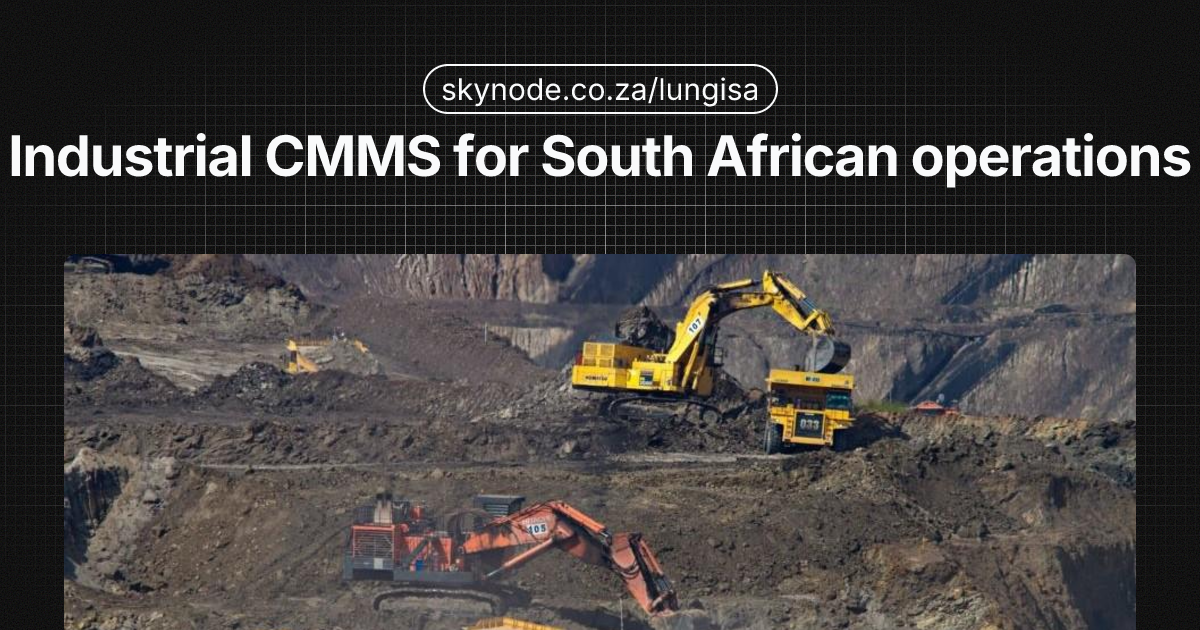
An asset register is the foundation of effective maintenance and compliance. Without a clear, up-to-date list of what you own, where it is, and how critical it is, you cannot plan preventive work, prioritise repairs, or demonstrate to inspectors that you are in control of your plant and equipment. In South Africa, where mining, manufacturing, and facilities face OHS Act requirements, MHSA obligations, and pressure to reduce unplanned downtime, a well-structured asset register is not optional. This guide explains what an asset register is, what to include, how to structure an asset hierarchy and criticality classification, how QR code labelling fits in, what the OHS Act expects, and how to get started — including the move from spreadsheets to a CMMS.
What Is an Asset Register and Why You Need One
An asset register (sometimes called an equipment register or asset list) is a structured record of the physical assets your operation maintains. Each record typically represents a single maintainable item: a pump, a conveyor, a generator, an HVAC unit, a lift, or a component that you track and maintain independently. The register is the single source of truth for what exists, where it is, who is responsible for it, and how it is maintained.
Why it matters:
- Planning — You cannot schedule preventive maintenance or allocate labour if you do not know what assets you have and which ones need recurring work.
- Prioritisation — When something fails or an inspector asks for records, you need to know which assets are safety-critical or production-critical so you can focus effort and proof where it counts.
- Compliance — The OHS Act and sector regulations require employers to maintain plant and equipment and to keep records. An asset register is the backbone for linking work orders, inspections, and certificates to specific equipment.
- Cost and performance — Once every repair and PM is linked to an asset, you can analyse failure rates, repair costs, and compliance status per asset or per site.
Without an asset register, maintenance tends to be reactive and ad hoc; with one, you can move toward planned maintenance and clear accountability. For an overview of how maintenance management and asset records fit together, see our guide on what is CMMS in South Africa.
What to Include in Your Asset Register
Every asset record should hold enough information to identify the asset, locate it, maintain it, and comply with regulations. The following fields are widely used in South African mining, manufacturing, and facilities.
Core identification
- Asset ID — A unique, stable code (e.g.
SITE-BLD-EQ-001). Never reuse IDs; they tie together work history, parts, and compliance. - Name or description — A clear, consistent name (e.g. “Primary conveyor drive C-01”, “Standby generator G-01”).
- Category — Type of asset (pump, motor, conveyor, HVAC, lift, fire panel, etc.) so you can filter and report by category.
- Location — Site, building, area, or room. Essential for multi-site operations and for assigning work by area.
Technical and commercial
- Manufacturer, model, serial number — For warranty claims, spare parts ordering, and traceability.
- Installation date — Helps with age-based maintenance and replacement planning.
- Criticality level — How important the asset is (see Criticality classification below). Drives prioritisation and PM frequency.
- Warranty end date — So you do not miss claim windows and you know when you take full responsibility for repairs.
Maintenance and compliance
- Assigned PM schedules — Which preventive tasks (and frequencies) apply to this asset. In a CMMS, these are linked so work orders generate automatically.
- OHS or statutory compliance requirements — Whether the asset falls under pressure equipment, lifting, fire, lift, or other regulations; what inspections or examinations are required and at what interval.
- Photos — Images of the asset and nameplate help technicians and contractors identify the right equipment on site and support audits.
Labelling and scanning
- QR code or barcode — A unique code physically fixed to the asset so technicians can scan to open the correct asset record (and create work orders) without typing or searching. This is especially useful when the asset register is managed in a CMMS.
You do not need every field on day one. Start with asset ID, name, category, location, and criticality; add manufacturer and serial data as you audit; then link PM schedules and compliance requirements as you formalise your maintenance plan.
How to Structure an Asset Hierarchy
An asset hierarchy organises assets from the broad (site) to the specific (component). It reflects how equipment is physically and logically grouped and makes it easier to assign location, roll up costs, and run reports by area or system. A common structure for South African operations is:
Site → Building or area → System → Equipment → Component
Example: mine shaft equipment
- Site: North Shaft
- Building/area: Hoist house
- System: Winding system
- Equipment: Main hoist motor H-01
- Component: Brake assembly (if you track and maintain it separately)
The hoist motor is the “asset” in your register; the brake might be a child asset or a component listed under H-01, depending on whether you maintain and record work at component level.
Example: manufacturing line
- Site: Plant A
- Building/area: Production hall 2
- System: Packaging line 1
- Equipment: Filler F-01, Capper C-01, Labeller L-01 (each as its own asset)
- Component: e.g. Filler valve assembly (if tracked separately)
Each major machine gets its own asset register entry; sub-assemblies can be components or child assets so that work and history roll up to the right place.
Example: commercial building
- Site: Head office campus
- Building/area: Tower B, basement
- System: Electrical / backup power
- Equipment: Standby generator G-B01, UPS unit UPS-B01
- Component: (often not used for building services unless you maintain at that level)
Hierarchy depth depends on your operation. Mining and manufacturing often use four or five levels; smaller facilities may use site, building, and equipment only. The important point is consistency: same rules across sites so that reporting and filters work the same way everywhere.
For a strategic view of how asset management fits into broader standards and lifecycle decisions, see ISO 55000 asset management in South Africa.
Criticality Classification
Criticality (often A/B/C or Critical / Important / General) determines how much attention an asset gets: inspection frequency, spare parts holding, and how fast you respond when it fails. Classify assets using clear criteria so that everyone applies the same logic.
Typical criteria
- Safety impact — Could failure cause injury, death, or a major environmental or regulatory breach? High safety impact usually means Critical (A).
- Production impact — Does failure stop a line, a shaft, or a key service? How long and how often? High impact pushes the asset toward Critical or Important (A or B).
- Repair cost and lead time — Expensive or long-lead repairs may justify higher criticality so that PM and spares are prioritised.
- Failure frequency — Assets that fail often may be upgraded in criticality so that root-cause analysis and PM are resourced properly.
Simple three-level scheme
- Critical (A) — Safety-critical and/or single point of failure for production; statutory inspections; high cost or long lead time. These get the most frequent PM, dedicated spares, and fastest response.
- Important (B) — Significant impact on production or operations but not single point of failure; or moderate safety/compliance role. Standard PM and normal response.
- General (C) — Low impact on safety and production; failure is inconvenient but not catastrophic. Basic PM or run-to-failure by design.
Apply the same criteria across sites so that “Critical” means the same thing in every plant or mine. Review criticality when equipment role or environment changes.
QR Code Labelling for Your Asset Register
QR codes (or barcodes) on each asset solve a practical problem: in a large plant or multi-site operation, technicians should not have to search by name or ID to find the right record. They scan the code and open the correct asset in the CMMS, then log work or create a work order against it.
Why use QR codes
- Speed and accuracy — No typing errors; the right asset is selected every time.
- Mobile-first — Technicians on phones or tablets scan at the asset, complete the work, and close the order without returning to a desk.
- Audit trail — Work is linked to the correct asset automatically, so history and compliance reports are reliable.
How to implement
- Generate a unique code per asset — Use the asset ID (or a dedicated “barcode” field) so the code maps 1:1 to the register.
- Print durable labels — Laminated or metal tags that survive dust, moisture, and cleaning. Place them where they are visible and scannable without climbing or dismantling.
- Link scanning to your CMMS — In a CMMS, scanning the code opens the asset record and can start a work order or log a quick note. If you still use spreadsheets, the code can encode a link to a row or a simple lookup page, but the full benefit comes when the register and work orders live in one system.
Starting with critical and important assets gives you the most value early; you can roll out QR codes to the rest of the register over time.
OHS Act Requirements for Asset Records
The OHS Act requires employers to maintain plant and equipment in a safe condition and to keep records that demonstrate this. An asset register does not by itself satisfy the Act, but it is the structure that lets you attach the right records to the right equipment.
- Machinery — General Machinery Regulations require maintenance and supervision by a competent person. Records of inspections, repairs, and maintenance should be traceable to the specific machine; your asset register is the place to link that work.
- Pressure equipment — Pressure Equipment Regulations specify examination and testing intervals. Each pressure vessel or boiler should appear in your register with its statutory due dates and certificates linked.
- Lifting equipment — Thorough examinations at defined intervals must be recorded per asset. The register identifies each crane, hoist, or lifting attachment and holds the history of examinations.
- Fire and life safety — Detection, alarm, and extinguisher systems are often subject to SANS and insurer requirements. Asset-level records help you prove that each system or device was tested and maintained on schedule.
In practice: one asset per maintainable item, with work orders and compliance due dates linked to that asset. When an inspector asks for evidence of maintenance on a specific piece of equipment, you pull the asset record and its attached history. For a detailed breakdown of employer duties and record-keeping, see our guide on OHS Act maintenance requirements.
Getting Started: From Audit to CMMS
Building or improving an asset register is iterative. A practical sequence:
1. Audit what you have
Walk the site (or sites) and list what is there: every piece of equipment you maintain or are legally required to maintain. Use existing spreadsheets, drawings, or walk-arounds with experienced staff. Capture at least: asset type, location, and a temporary or permanent ID. Do not aim for perfection; aim for a complete list. Prioritise safety-critical and statutory equipment first.
2. Decide hierarchy and criticality
Apply the same hierarchy (site → area → system → equipment) across the operation and assign criticality (A/B/C) using the criteria above. Document the rules so new assets are classified consistently.
3. Populate the register
Add the fields that matter most: ID, name, category, location, manufacturer/model/serial where available, installation date, criticality, and any known statutory requirements. Add photos and QR codes for critical assets first.
4. Move from spreadsheet to CMMS when it pays off
A spreadsheet asset register works for a small number of assets and one or two users. As the list grows, or when multiple people need to update it and link work orders, the limits of spreadsheets show: version control, audit trail, and automatic PM generation are weak. Migrating your register into a CMMS gives you one system for assets, work orders, and compliance. For a comparison of spreadsheets and CMMS in the South African context, see CMMS vs spreadsheets.
5. Start with critical assets
You do not need to complete every asset before going live. Load critical (A) and important (B) assets first, assign PM schedules and compliance due dates, and start capturing work against them. Add the rest over time. This gets you compliance and prioritisation benefits quickly.
How a CMMS Manages Asset Registers
A CMMS (computerised maintenance management system) is built around the idea of an asset register. Each asset is a record in the system; work orders, PM schedules, spare parts, and compliance due dates are linked to that record.
- Single register — One list of assets, with hierarchy (parent/child or location tree), so you can view by site, building, or system.
- PM and work orders — PM schedules are attached to assets; the CMMS generates work orders by date or meter. Completed work is recorded against the asset, so history and “last done / next due” are always current.
- Compliance — Statutory tasks and due dates are defined per asset; reports show what is overdue or due soon for audits and inspectors.
- QR integration — Technicians scan the asset’s QR code to open the record and create or complete work orders from the field, often with offline support for areas with poor connectivity or load-shedding.
Once your asset register lives in a CMMS, it stops being a static list and becomes the backbone of daily maintenance and proof of compliance. For a foundational explanation of how a CMMS works in South Africa, see what is CMMS.
Summary and Next Steps
An asset register should include asset ID, name, category, location, technical data, criticality, PM schedules, and OHS-related requirements; QR codes link physical equipment to the register and speed up data capture. Use a clear hierarchy (site → area → system → equipment → component) and classify assets by criticality (A/B/C). Align with OHS Act and sector regulations by linking work and certificates to each asset. Audit what you have, define hierarchy and criticality, then populate the register starting with critical assets. When the operation’s size and compliance needs justify it, consider moving from a spreadsheet to a CMMS.
If you would like to see how Lungisa manages asset registers, preventive maintenance, and compliance for South African mining, manufacturing, and facilities, you can explore Lungisa or contact the Skynode team to discuss your requirements.
E kwadilwe ke
Lungisa Team