
CMMS for Mining in South Africa: Features, Compliance, and Best Practices
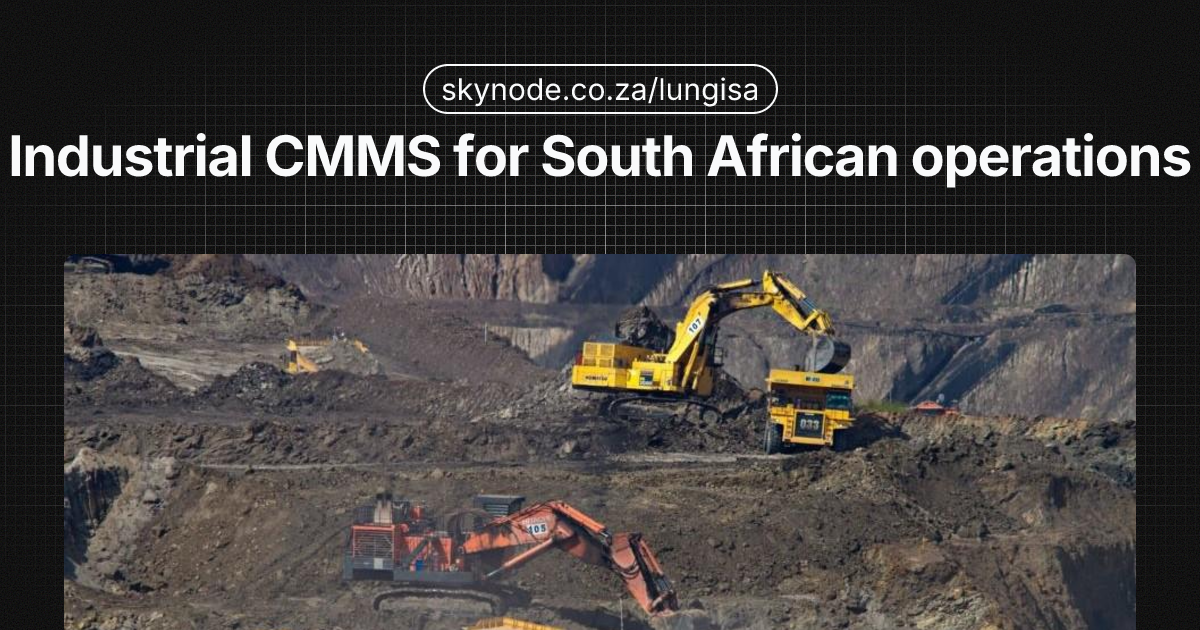
South African mines face a maintenance challenge that goes far beyond keeping machinery running. Underground access, harsh conditions, strict regulatory pressure from the Mine Health and Safety Act (MHSA), and a persistent skills shortage make planned, traceable maintenance essential. A CMMS for mining South Africa can centralise work orders, statutory schedules, and compliance records so that gold operations in Gauteng, platinum mines in Limpopo and the North West, and coal operations in Mpumalanga can reduce unplanned downtime and meet inspector expectations — even when connectivity or power is unreliable. Load-shedding and remote sites make offline-capable, mobile-friendly maintenance software more important than ever. This article sets out the unique challenges of mine maintenance, how operations typically manage it today, what a mining CMMS must deliver, key use cases, compliance automation, and where the ROI shows up in real terms.
Why Mine Maintenance Is Different
Mining maintenance is not the same as maintaining a factory or an office block. The environment, access, regulation, and cost of failure create a distinct set of demands that generic maintenance software often fails to address.
Underground Access and Harsh Conditions
Underground mines have limited access windows. Shaft time is precious; equipment that fails below ground can strand workers, halt production, and trigger emergency protocols. Dust, moisture, vibration, and confined spaces accelerate wear on winding gear, conveyors, ventilation fans, and mobile equipment. Technicians may work in areas with no cellular or Wi‑Fi coverage, so any system that depends on constant connectivity will leave gaps in record-keeping exactly where evidence matters most. A CMMS for mining in South Africa must therefore support offline capture: work orders, checklists, and completion data entered underground and synced when the technician returns to surface or to a connectivity point.
Regulatory Pressure: MHSA and the DMRE
The Mine Health and Safety Act 29 of 1996 and its regulations impose statutory maintenance on a wide range of equipment and systems. Winding ropes, conveyance and braking systems, pressure equipment, electrical installations in hazardous areas, ventilation systems, and rescue equipment (including self-contained self-rescuers, SCSRs) must be inspected, tested, and maintained at defined intervals. The Department of Mineral Resources and Energy (DMRE) enforces compliance through inspections and can request records at any time. Missing or overdue statutory tasks are not only a safety risk but a legal and reputational one. Maintenance managers need a system that schedules statutory work, tracks due dates, and produces audit-ready reports. For a detailed breakdown of what the law requires, see our guide on MHSA maintenance requirements for mining in South Africa.
Skills Shortage and Knowledge Retention
The mining sector continues to grapple with a shortage of experienced artisans and maintenance planners. When skilled staff leave or retire, tribal knowledge about critical assets — which components fail first, which PMs prevent the most downtime — can disappear. A CMMS that holds asset histories, standard job plans, and checklists helps new technicians follow proven procedures and reduces dependence on a few key people. Documented work history also supports root-cause analysis and continuous improvement, so the organisation learns from every failure and refinement. In regions such as Gauteng, the North West, and Mpumalanga, where mines compete for a limited pool of qualified technicians, a system that makes onboarding faster and work more structured is a tangible advantage.
How Mines Manage Maintenance Today
Before investing in or upgrading a CMMS, it helps to recognise the common starting points. Many South African mines still rely on a mix of the following.
Paper and Clipboards
Job cards, inspection sheets, and statutory registers are often still paper-based, especially underground where connectivity is absent. Paper is simple but creates problems: duplication of effort when data is typed into a spreadsheet or ERP later, loss or damage of records, and no real-time visibility for planners or management. When an inspector asks for proof of a specific inspection, finding the right sheet can be slow or impossible. Paper does not scale across multiple shafts, sections, or sites.
SAP PM and Other Enterprise ERP Modules
Larger mines frequently use SAP Plant Maintenance (PM) or similar ERP modules for work orders, asset master data, and procurement. These systems are powerful but complex and expensive to configure and maintain. They are rarely optimised for mobile or offline use at the face or in the workshop. Customisation to align with MHSA statutory registers, certificate tracking, and DMRE-style reporting often requires significant consultancy. Mid-tier and smaller operations may find the cost and complexity prohibitive. A dedicated CMMS for mining South Africa can complement or replace ERP maintenance modules where the focus is on usability, compliance templates, and offline capability.
Spreadsheets
Excel and Google Sheets are widely used for asset lists, PM calendars, and spare-parts tracking. They are flexible and familiar but break down as data grows and as multiple people need to update the same information. Version control, audit trails, and integration with work execution are weak. Statutory due dates buried in spreadsheets are easily missed; reporting for inspectors usually means manual compilation. Many mines that rely heavily on spreadsheets know the pain of “the file is on someone’s laptop” or “we’re not sure if that schedule is current.” As the operation scales to more shafts, more equipment, and stricter DMRE scrutiny, the spreadsheet approach becomes a liability. A CMMS replaces this patchwork with a single system where work is scheduled, assigned, executed, and recorded in one place. For an overview of what a CMMS is and how it fits into maintenance management, see what is CMMS in South Africa.
What a Mining CMMS Must Have
Not every CMMS is suitable for mining. The following capabilities are non-negotiable for South African mines.
Offline Mode for Underground and Remote Sites
Technicians must be able to receive work orders, complete checklists, log labour and parts, and capture photos or notes without a live connection. Data should sync automatically when the device is back in range. Without offline mode, either work goes unrecorded or paper is used as a bridge, reintroducing double capture and error. For operations in the Bushveld, the Witwatersrand, or remote coal fields, offline capability is a must-have.
MHSA-Oriented Templates and Statutory Registers
A CMMS for mining South Africa should offer or support templates that align with MHSA and DMRE expectations: statutory maintenance schedules for winding gear, conveyors, ventilation, pressure equipment, electrical installations, and rescue equipment. Built-in or configurable statutory registers — listing each required task, frequency, last done, and next due — reduce the risk of missing a due date and speed up preparation for inspections. When the system generates work orders from these schedules and records completion, the audit trail is already in place.
Equipment Hierarchies and Criticality
Mines have complex asset structures: a shaft has winding gear, conveyors, ventilation fans, and electrical substations; each of those may have sub-assets and components. The CMMS should support parent–child hierarchies and, where useful, criticality ratings so that PM and response priorities reflect the impact of failure. A breakdown on a primary conveyor feeding the plant is not the same as a minor pump in a non-critical circuit. Hierarchies also help with reporting by area, shaft, or asset type.
Safety Permits and Lock-Out
Work in hazardous areas or on energised systems often requires permits to work (PTW), lock-out/tag-out (LOTO), or similar controls. A mining CMMS should allow work orders to be linked to permit requirements and to record that permits were issued and cleared. That keeps safety and maintenance in one workflow and gives auditors a clear trail.
Spare Parts and Inventory for Remote Sites
Mining sites are often far from central warehouses. The CMMS should support multiple stock locations, reorder points, and visibility of what is available at which site or store. When a technician is underground or at a remote plant, knowing that a critical part is in the surface store — or that it must be ordered — avoids wasted trips and extended downtime. Integration with procurement or ERP is valuable for larger operations, but even basic multi-location inventory in the CMMS improves planning. Mines in the North West or Limpopo, for example, may have a central store at the head office and satellite stores at each shaft or plant; the system should allow planners to see stock levels and consumption by location so that critical spares are positioned where they are needed before a breakdown occurs.
Key Use Cases for a CMMS in Mining
A CMMS for mining South Africa delivers value across the full range of mine equipment. The following use cases are among the most critical.
Winding Gear and Rope Systems
Winding equipment is safety-critical and heavily regulated. Rope examination, conveyance and brake testing, and related statutory tasks must be scheduled and recorded. The CMMS should generate work orders from statutory schedules, allow technicians to complete checklists and log results (including measurements and discard criteria where applicable), and maintain a clear history for each rope and component. Gold mines in Gauteng with deep-level shafts rely on this for both compliance and reliability.
Conveyor Systems
Conveyors move ore and material through the mine and plant. Belt condition, idlers, drives, and take-up systems need regular inspection and maintenance. PM schedules by time or running hours, plus reactive work orders for failures, keep conveyors in the CMMS alongside other assets. Backlog and failure history help planners prioritise and avoid cascading stoppages.
Ventilation and Fans
Underground ventilation is essential for gas management, temperature, and dust control. Main fans, secondary fans, and ventilation doors and controls must be maintained and inspected as per MHSA and mine standards. Scheduling fan inspections and filter replacements in the CMMS, with completion captured on mobile (including offline), ensures nothing is missed and records are available for the DMRE.
Mobile Equipment
Loaders, haul trucks, drill rigs, and other mobile equipment run in demanding conditions. Hour-based or cycle-based PM (oil changes, filter replacements, brake and steering checks) can be driven from the CMMS with work orders generated from meter readings. Asset history supports warranty claims, rebuild planning, and replacement decisions. Platinum operations in Limpopo and the North West, with large fleets of underground and surface mobile equipment, benefit from a single system for both fixed and mobile assets.
Processing Plant
Crushing, milling, flotation, smelting, and refining equipment represent another layer of critical assets. Pumps, motors, gearboxes, and process vessels need preventive and condition-based maintenance. A CMMS that ties PM schedules to asset hierarchies and captures work and parts usage builds a full picture of plant reliability and cost. Coal preparation plants in Mpumalanga and mineral processing facilities elsewhere use the same principles: schedule it, execute it, record it.
Compliance Automation: MHSA, DMRE Inspections, and Certificates
Manual compliance is error-prone and labour-intensive. A CMMS for mining South Africa can automate much of the heavy lifting.
Statutory Schedule Generation and Due-Date Tracking
Define statutory tasks (e.g. winding rope examination every X days, SCSR inspection monthly) once in the CMMS. The system generates work orders as due dates approach and tracks completion. Overdue statutory work is visible on dashboards and in reports so that maintenance and safety managers can act before an inspector does. This aligns directly with MHSA maintenance requirements and DMRE expectations.
DMRE Inspection Readiness
When the DMRE announces or conducts an inspection, having a single source of truth for statutory maintenance, equipment history, and certificates reduces preparation time. Reports that list “all statutory tasks by due date,” “completed vs overdue,” and “last inspection date per asset” give management and safety representatives the evidence they need. A CMMS that has been used consistently is far easier to defend than ad hoc spreadsheets or boxes of paper.
Certificate and Calibration Tracking
Lifting equipment, pressure vessels, electrical test equipment, and rescue apparatus often require periodic certification or calibration by approved bodies. The CMMS can hold certificate due dates per asset and generate alerts or work orders when renewals are approaching. That prevents equipment from being used past its certification date and supports audit readiness. Mines that run multiple winders, cranes, or pressure systems benefit from a single register of all certificates and due dates, so that nothing falls through the cracks when the DMRE or an internal auditor asks for proof of compliance.
ROI: What Downtime Really Costs
Justifying a CMMS for mining in South Africa is easier when the cost of unplanned downtime is clear. Although figures vary by mine size, commodity, and depth, industry benchmarks illustrate the scale.
In gold mining, an hour of production lost at a deep-level shaft can represent hundreds of thousands of rand in deferred output, not counting the cost of emergency response, standby labour, and possible damage to equipment or infrastructure. A single winding-system failure can idle an entire shaft for a shift or more; conveyor or ventilation failures underground have similar ripple effects. Platinum concentrators and smelters similarly lose substantial revenue per hour of unplanned stoppage — process plants are designed for throughput, and every hour offline is revenue and margin foregone. Coal operations supplying Eskom or export markets face contractual and reputational risk when delivery is interrupted; penalties and lost spot sales add to the direct cost of the stoppage. Reducing unplanned downtime through better planned maintenance, faster response, and fewer “no parts” or “no information” delays directly protects revenue and reduces overtime and emergency repair costs.
A CMMS does not eliminate failures, but it improves the odds: PMs are completed on time, backlogs are visible, critical spares are tracked, and history supports better decisions. For many mines, the payback comes from a small reduction in unplanned stoppages (even a few avoided incidents per year can justify the investment) and from avoiding a single compliance finding or improvement notice. The cost of an improvement notice — remediation, possible production impact, and management time — often exceeds the annual cost of a fit-for-purpose CMMS. Comparing options with a clear view of compliance and offline needs is essential; our best CMMS software South Africa comparison helps narrow the field.
Summary and Next Steps
A CMMS for mining South Africa must support the realities of mine maintenance: offline capture for underground and remote sites, MHSA-aligned statutory schedules and registers, equipment hierarchies, safety permits, and spare-parts visibility across sites. Use cases span winding gear, conveyors, ventilation, mobile equipment, and processing plant. Compliance automation — statutory due-date tracking, DMRE-ready reports, and certificate management — reduces the risk of overdue tasks and prepares operations for inspections. The ROI case is strengthened by the high cost of unplanned downtime in gold, platinum, and coal and by the value of audit-ready, consistent records.
If you are evaluating or implementing a CMMS for a South African mine, start by mapping your statutory obligations and current pain points (paper, spreadsheets, or underused ERP). Then prioritise offline capability, MHSA-oriented templates, and the ability to report clearly to the DMRE. Skynode’s Lungisa includes mining-focused templates and compliance tracking designed for local operations; if you would like to see how pre-built mining templates can accelerate your setup, explore Lungisa or contact the Skynode team to discuss your requirements.
Written by
Lungisa Team